Hacine and Malek Bouali: Discipline and Violent Punishment
And Their Children After ThemHacine Bouali and Malek Bouali’s father-son relationship moves between ordinary household routines, paternal efforts to direct Hacine’s life, and violence used as punishment. Malek Bouali’s authority is framed by his own long experience as an immigrant worker in Heillange, but it does not make him a source of uncomplicated protection: after promising Hélène Casati he would speak to Hacine about a missing motorcycle, he attacks his son when Hacine returns home. The episode leaves their relationship defined by a sharp divide between the father’s declared responsibility and the fear his discipline produces.
Family Life and Social Context
Malek Bouali’s experience of work and exclusion forms an important backdrop to his role as a father. He and Rania emigrated from a poor country and found a kind of refuge in Heillange. Malek Bouali worked at the steel mill for forty years, remaining punctual and outwardly compliant while facing a workplace hierarchy in which North African and Black workers were placed at the bottom. The distinctions between workers did not, in his experience, rest simply on skill or seniority: access to better positions was restricted, and even workers who advanced could remain objects of suspicion. The insults directed at him and other Arab workers grew less overt with time, but did not disappear. He had earned a promotion, yet the narrative presents that advancement within a system that continued to mark him as subordinate.
This history does not explain every choice Malek Bouali makes with Hacine, but it places their family life alongside the pressures that have shaped the father’s place in the valley. The account gives no sign that Hacine fully recognizes this background. Indeed, his father’s speech becomes a source of embarrassment to him: although Malek Bouali has lived in the area for nearly thirty-five years and acquired the local accent, he still speaks approximate French. Hacine feels like hiding when his father speaks. Their difference is therefore not only generational; it is also a difference in how each experiences the father’s public identity and the stigma attached to it.
Household Routine and Expectations
In one domestic scene, Malek Bouali tells Hacine that people have seen his brother. Hacine dismisses the report. The exchange does not develop into a longer conversation, and the scene soon returns to the routine of the home. Malek Bouali cooks their usual meal, turns up the radio, and sits down with Hacine to eat. The father drinks water while Hacine pours grenadine; they eat without speaking. Their shared table establishes a familiar closeness of circumstance, but not an ease of conversation.
When the telephone rings, Hacine answers a call from his mother, who says she is looking forward to seeing him and asks whether he is behaving well. Malek Bouali then takes the receiver and speaks with his wife in Arabic for several minutes. Hacine withdraws to his bedroom so as not to disturb them. The scene shows family connection continuing across distance, but it also places Hacine at the edge of his parents’ conversation: his mother calls him directly, while the longer exchange belongs to his parents. The quiet meal and his retreat make household proximity distinct from emotional openness.
Malek Bouali’s expectations become clearer when he asks whether Hacine has gone to Heillange City Hall and whether there was any work. Hacine reports that there was no job. His father responds that Hacine has to work and insists that, if someone wants work, they can find it. The exchange sets the father’s belief in effort against the absence of an available position. Malek Bouali speaks with certainty; Hacine answers with the practical obstacle of unemployment. The scene offers no resolution, only a difference between paternal expectation and the conditions Hacine reports.
The Missing Motorcycle and a Promise
Malek Bouali’s relationship with Hacine is drawn into a dispute over a missing motorcycle when Hélène Casati visits the Bouali home with Anthony Casati. While Anthony is briefly away, Hélène explains the matter to Malek Bouali, carefully presenting the facts and identifying the theft without speaking to him harshly. Malek Bouali listens as she describes what has happened. The narrative places his response within the memory of his working life: he has spent decades in an institution where Arab workers were treated as inferior and where advancement did not erase suspicion. Hélène’s account unsettles him, and he appears to feel both responsible and old.
Over tea, Malek Bouali maintains that Hacine is not the kind of person Hélène suspects. The scene complicates this defense: he is not portrayed as simply deceiving her, but neither is he shown as committed to establishing the truth at that moment. He is acting in the role of a father, defending his son while listening to the facts. When Hélène continues to explain, he promises that he will speak to Hacine when he comes home and that, if Hacine has taken the motorcycle, he will make him return it. He tells Hélène she can trust him. She chooses to believe the promise and feels a moment of tenderness toward him, whom she sees as decent but humiliated.
The promise briefly makes Malek Bouali a mediator between Hélène’s demand for accountability and Hacine’s absence from the conversation. Yet it also establishes a standard he will enforce within the family. Hacine is not present when his father gives his word, and the narrative does not show Malek Bouali first questioning him about the motorcycle in a calm exchange. The gap between the promise and what follows is central to the relationship: the father’s stated intention to address the matter becomes inseparable from his use of force.
Punishment and Its Aftermath
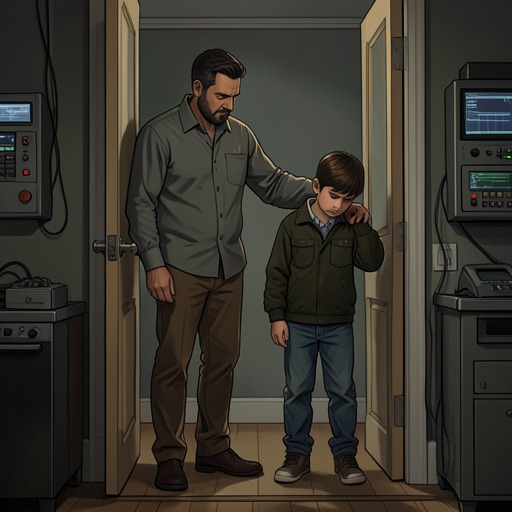
When Hacine comes home, he tells his father that he is tired and intends to go to bed. Malek Bouali has been waiting for him. He strikes Hacine with an ax handle, then locks him in his room. The account presents this not as a measured conversation or a negotiated punishment, but as a sudden exercise of paternal power. Hacine is left confined and in pain, while his father does not explain himself during the attack. The private home, previously a place of meals and routine, becomes a space where Malek Bouali can impose control without discussion.
During the night, Hacine tries to understand what has angered his father. He feels ashamed as well as hurt, but cannot identify a reason that satisfies him. From the next room he hears Malek Bouali praying; the detail conveys the seriousness with which the father regards the situation, but does not clarify his thoughts or soften the consequences for Hacine. The locked door continues to govern Hacine’s movements through the night. In the morning, father and son speak directly, man to man. Malek Bouali threatens to kill Hacine himself if he ever does something like that again. Hacine says nothing in response.
The episode closes not with reconciliation or an account of the motorcycle being returned, but with Hacine’s own resolve: he intends to find Anthony Casati and his cousin. His father’s punishment has not produced a visible change of mind or a settled agreement. Instead, the relationship’s imbalance is exposed. Malek Bouali can confine and threaten his son, but the scene ends with Hacine holding on to an intention of his own, directed beyond the household toward those he considers responsible.
Significance of the Relationship
The father-son bond is marked by the difference between care as responsibility and authority as control. Malek Bouali cooks for Hacine, shares the home with him, speaks with Hacine’s mother, and takes Hélène Casati’s complaint seriously enough to promise action. Yet those forms of involvement do not guarantee a safe or communicative relationship. When Hacine returns, the father’s promise is followed by an assault and a threat, rather than by the discussion Hélène had expected.
The contrast between the two men’s positions also remains unresolved. Malek Bouali’s life has been shaped by a workplace hierarchy that disciplined and demeaned him; within the family, he exercises power over his son through discipline of his own. The narrative does not equate the two situations, but places them in tension: a man accustomed to subordination in public life commands authority at home, while Hacine experiences that authority as punishment and confinement. Their relationship thus joins the ordinary pressures of work, family expectation, and unemployment to a more immediate conflict over trust, responsibility, and the limits of paternal power.